


Production Zone 7.1 (SX 7.1)
Production Zone 7.1 (SX 7.1)
Total Land Area 69,831 m² • Starting from 3 USD/m²/month • Available from Jan, 2027
Detail Information

Total Land Area
69,831 m²

Rental Rate
3 USD/m²/month

Lease Term
3 - 10 years

Lease Move-in Date
Jan, 2027
Factory Building Specifications
Dimensions
30 x 114 m (x1)
65 x 91 m (x1)
65 x 105 m (x1)
65 x 144 m (x2)
Area
4,320 m²
5,915 m²
6,825 m²
9,360 m²
Total Quantity:
5 factories
Detailed Planning Layout

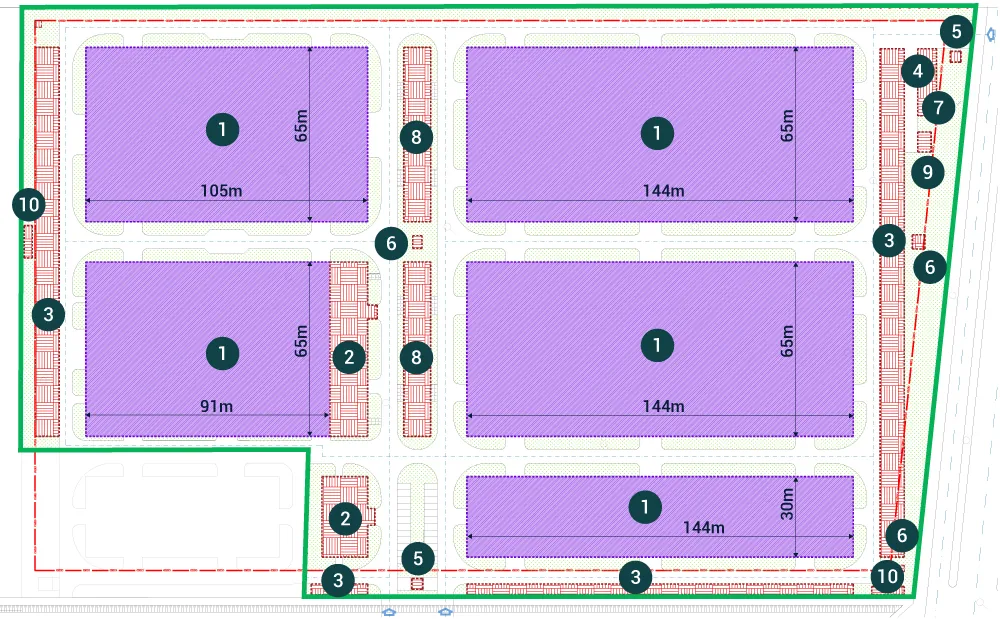
Detailed Planning for Phase I - Production Zone 7.1
Area Allocation
Factory & Auxiliary Buildings Area
42,577.0 m² (60.97%)
Roads & Pavement Area
14,214.6 m² (20.36%)
Green Landscape Area
13,039.4 m² (18.97%)
Total Land Area:
69,831 m² (100%)
Detail of Factory Buildings & Ancillary Structures

1
5 Factory Buildings
35,780 m²

2
2 Administration Buildings
1,445.4 m²

3
4 Parking Areas
3,670.5 m²

4
1 Technical Building
175 m²

5
2 Guard Houses
32 m²

6
4 Electrical Substation
54 m²

7
1 Firefighting Water Tank
175 m²

8
2 Auxiliary Service Buildings
1,300 m²

9
1 Waste Storage
37.5 m²

10
2 Inverter Stations
72.6 m²
Photos of Production Zone
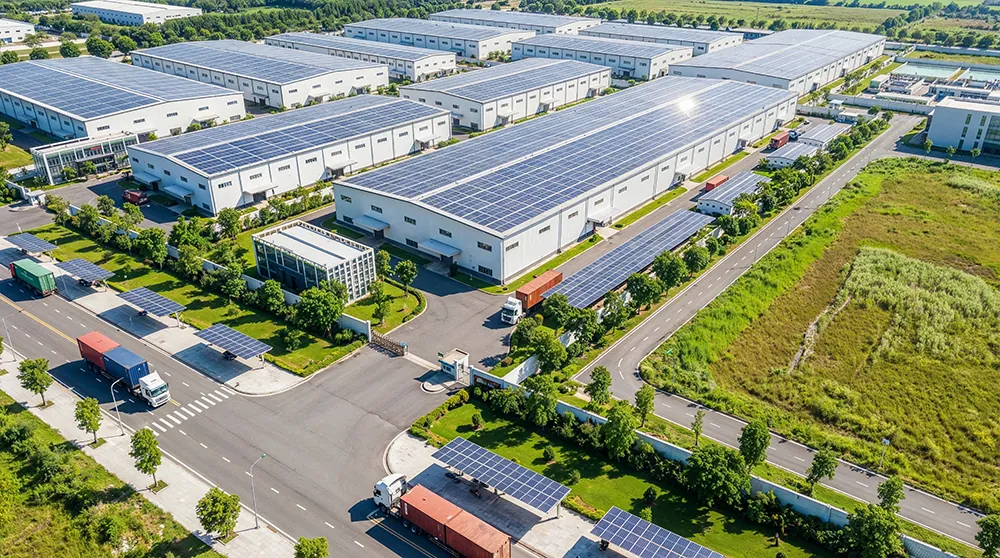
Factory Building
Overview of Production Zone 7.1
Key Features

Production Zone 7.1 covers 69,831 m² with five factories of 4,320–9,360 m², supporting different production scales.
The zone includes single-storey factories and buildings with partial second floors, offering flexible production and support spaces.
Production, management, storage, and circulation areas are centrally connected for efficient operations.
Integrated infrastructure, fire protection, energy, and utilities ensure stable operations and future expansion.
Suitable for
Electronics, precision engineering, supporting industries, and industrial manufacturing enterprises.
Export manufacturers seeking reliable logistics and operational infrastructure.
Enterprises operating multiple production lines and support functions in one zone.
Enterprises starting new projects or planning production expansion.
Key Benefits
Accommodates multiple production lines across five integrated factory buildings.
Reduces implementation time through coordinated infrastructure and prepared facilities.
Improves logistics through internal roads, parking, and on-site utilities.
Supports reliable long-term operations with integrated technical and energy systems.


